
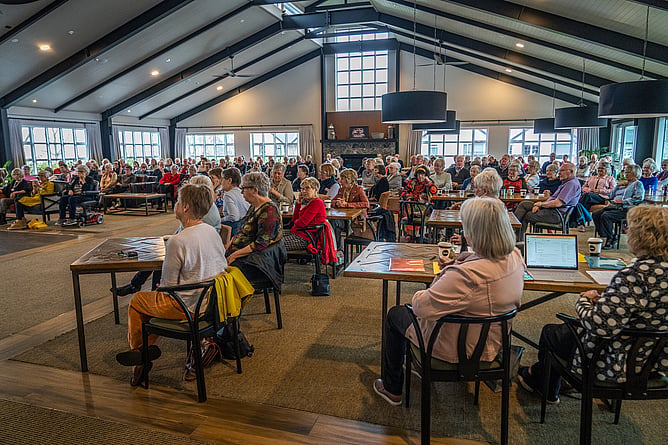
By 9.45 on a U3A Cambridge morning, the doors have been open for fifteen minutes and the room is already more than half full. Not people sitting waiting for something to start, but people talking, laughing, catching up over coffee. The lecture does not begin until 10.30. They are there because they want to be, and they are happy about it. When the speaker finishes, they do not leave. They stay to talk to each other and to the person at the front, sometimes for a long time. We get thank you emails afterwards, and they are not the polite kind. People write because they felt something worth expressing.
In this newsletter, we wrote about the way we give money, and why we have become more deliberate about where it goes. But money is only one way of giving, and for many people it is not the primary one. The other currency is time, and in some respects it is harder to replace when it stops.
Most of the community organisations that make daily life better than it would otherwise be are held together by people who said yes when someone asked, or who looked at something that did not exist and decided to build it. The decision is rarely dramatic. It tends to be a conversation, a committee meeting, a phone call that ends with you agreeing to take something on. And then, if the fit is right, it becomes part of how you spend your weeks.
We think about this a lot, because the people in our firm are involved in a range of things that have nothing to do with financial planning.
Peter has been secretary and treasurer of Cambridge Cricket for around five years. In that time, the club has grown significantly enough that it has just appointed its first paid employee to manage the next stage of development. That kind of growth does not happen without the structural work that goes on behind the scenes, the administration, the finances, the governance, done consistently by people who are not paid to do it. The players and families who turn up on a Saturday afternoon to watch and play are not thinking about the treasurer. They are thinking about cricket. That is exactly how it should be.
The same logic applies to most community organisations. The people who benefit from them rarely see the hours that go into making them function. What they see is the thing itself: a lecture that makes them think, a festival that gives them somewhere beautiful to spend a Saturday, a cricket club that their children want to be part of. The giving is invisible, but the effect is not.
What has struck us, over years of this kind of involvement, is that the most durable community contributions tend to come from people who are genuinely enjoying themselves. Not every moment of it, because committees and logistics and the occasional difficult conversation are part of the deal. But the underlying experience.
The people who burn out tend to be doing something out of obligation, because no one else would, or because they felt they should. The people who keep going for eight years, or who launch a new programme for a fifth consecutive year, or who start something from scratch because it ought to exist, tend to be the ones for whom the work itself produces something worth having.
We think that something is joy, or close enough to it. The satisfaction of watching a room fill up with people who want to be there. The feedback that comes in after an event that people genuinely enjoyed. The knowledge that a club or an organisation is healthier than it was when you started. These are not small things. They are the reason people keep saying yes.
And the joy, when it works, runs in both directions. This is what makes voluntary community work different from other kinds of contribution. The person driving a friend or client to a medical appointment they could not otherwise get to is doing something unglamorous and time-consuming. But they are also, in most cases, doing something that matters enormously to the person in the passenger seat, and they know it. That knowledge is its own return.
We are writing this as a companion to our other piece on charitable giving, and the connection is not coincidental. Both pieces are really about the same thing: what holds communities together when the formal structures, government funding, large institutional donors, the organisations with marketing budgets and direct mail campaigns, are doing less than they were. The answer, in most places, is people. Specific people who decided that something mattered and showed up for it, repeatedly, over time.
And while we are on the subject, thank you. To everyone who drives someone to an appointment, runs the committee, coaches the team, organises the event, shows up week after week for something that needs them. The people on the receiving end know what it means, even when they do not always say so.
That is not a romantic idea. It is just what we have observed. And it suggests that the most useful question is not whether you have enough money to make a difference, but whether you have something you are good at and willing to give, and somewhere that needs it.