
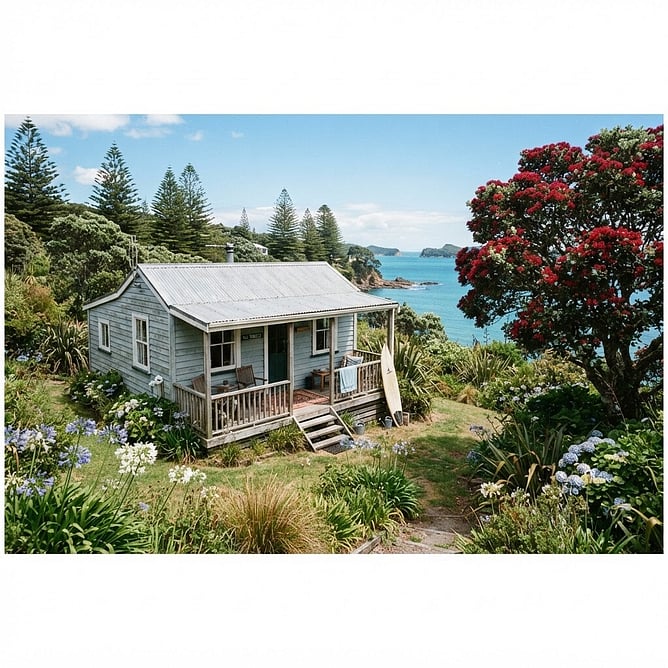
Ask most people what their bach costs and they will give you the rates bill and the insurance premium. Maybe a rough number for maintenance if they have had a bad year.
That is not actually what the bach costs. It is what the bach costs when nothing goes wrong and you are not counting everything.
A bach is a legitimate thing to own. Families build years of memories in them. They are places people value. But a bach is also a financial commitment that sits inside a retirement plan, and most retirement plans do not carry an honest number for what that commitment adds up to.
Start with what you actually pay
A coastal bach valued at around $650,000 has a reasonable starting-point set of annual costs. Council rates in the $3,500 to $5,000 range, depending on the district. Insurance at $4,000 to $6,000 or more if the location carries flood, coastal, or earthquake risk, which most bach locations do. A maintenance allowance of around $6,500, which is the standard one-percent-of-value planning benchmark used by the NZ Property Investors Federation.
That puts the baseline somewhere between $14,000 and $17,500 per year, before a single repair bill or emergency.
The one-percent maintenance figure is a floor, not a ceiling. Coastal properties age faster than inland ones. Salt air is hard on paint, timber, roofing, and fittings. A bach that presents well on a summer visit may have deferred maintenance that only becomes visible when something fails. Roof replacements, repainting, decking, septic systems, and heating upgrades are all foreseeable costs over a fifteen-to-twenty-year retirement. The question is not whether they will happen, but when and in what combination.
Then project it forward
The number that matters for retirement planning is not the cost today. It is the cost in ten years.
Council rates across New Zealand rose 34 percent between 2022 and 2025, against general inflation of around 14 percent over the same period. House insurance premiums rose roughly 56 percent nationally over the same three years, with coastal and high-risk locations seeing larger increases still. Maintenance costs track construction costs, which have also risen faster than general inflation.
At a five percent annual growth rate across all three categories, which is moderate given recent trends, those starting costs of $14,000 to $17,500 reach $23,000 to $28,500 after ten years and $37,000 to $46,000 after twenty. At higher rates of increase, the trajectory is steeper.
That is what the bach actually costs, projected forward. It is the number the retirement plan has to carry.
The income question
Some bach owners offset holding costs by renting the property out, particularly over summer. This works to a point, but holiday rental income is less reliable than it might appear.
Peak weeks generate reasonable income. Shoulder-season weeks are harder to fill. Platform fees for Bookabach or Airbnb typically run at 15 to 20 percent of gross income. The property needs to be in good condition for every guest arrival, which accelerates wear and increases maintenance frequency. Bookings fall away in bad summers. And many bach owners find that renting the property conflicts with the reason they own it, because the weeks they want to use it are the weeks guests are willing to pay for.
Net rental income from a bach, after platform fees, cleaning costs, linen, repairs between lets, and the weeks left vacant, is rarely what the gross figure suggests. It reduces the holding cost burden but seldom eliminates it. The retirement plan still needs to carry the shortfall.
What the rest of the plan has to do
A bach that is not rented at all is a lifestyle asset with real ongoing costs and no income. There is nothing wrong with that as a deliberate choice, but the retirement plan has to be sized to carry those costs explicitly, alongside all the other retirement income needs.
Where this tends to go wrong is not in the decision to own the bach but in the assumptions built into the plan around it. The rates figure from five years ago. The insurance premium from before the recent run of increases. A maintenance allowance that reflects what was spent last year rather than what is foreseeable over the next ten. And no projection of what those costs become at the far end of a twenty-year retirement.
When we work through this with clients who hold a bach, the number that tends to shift their thinking is not the current annual cost. It is the projected cost in year fifteen or year twenty of retirement. At that point the bach may still be a source of real family value, but the financial plan needs to demonstrate that it can carry that cost at the higher end of the range, not just the middle.
The decision worth revisiting
We are not making a case that baches should be sold. Many clients hold them throughout retirement and never regret it. But the decision to keep holding a bach deserves to be a conscious, informed one, revisited periodically as costs change and the retirement plan evolves.
The clients who manage this well tend to share a few habits. They know what the bach actually costs each year, net of any rental income. They review insurance annually rather than auto-renewing. They have a rough view of what significant maintenance events are coming and when. And they have confirmed that the retirement plan can carry the bach's costs at the higher end of the plausible range, not just on current figures.
The clients who find the bach most stressful in retirement are usually those who carried an optimistic cost assumption into retirement and discovered the real number later, when there was less flexibility to absorb it.
Our white paper, You Can't Eat Bricks, covers property holding costs in retirement in full, including the combined cost picture for clients who hold both a bach and an investment property, the insurance picture for coastal and high-risk locations, and the seven questions worth working through before your next planning conversation.
Download it at the link below.